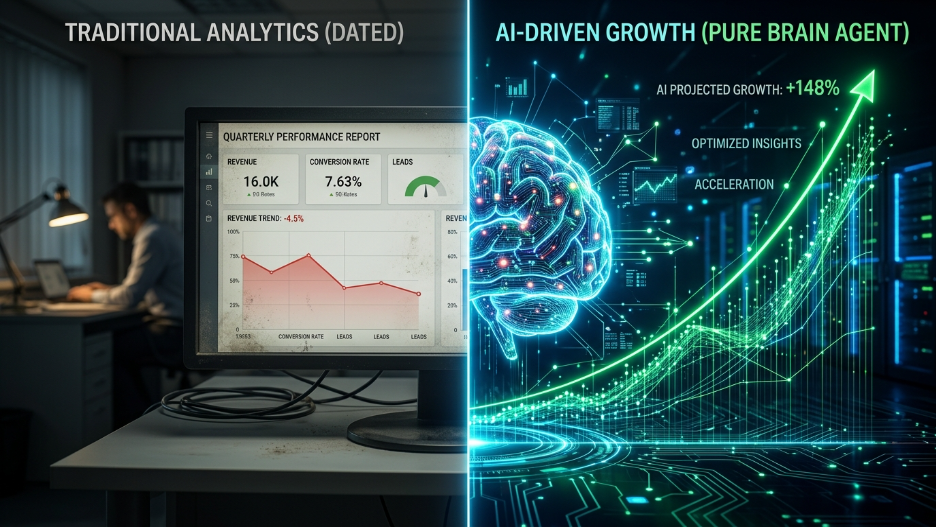
Marketing executives are staring at their dashboards in confusion. Traditional website traffic is declining. Organic clicks are dropping. Yet direct brand searches and revenue are actually increasing.
This disconnect comes from the rise of large language models and generative AI. Your brand visibility is expanding in the zero-click economy, but your standard tools cannot see it. Projections show LLM traffic will overtake traditional Google search by 2027. If your strategy relies on click-based metrics alone, you are navigating blind.
Quick Overview
LLM visibility measures how often and how accurately AI models like ChatGPT, Gemini, Claude, and Perplexity mention or recommend your brand. Unlike traditional SEO, it is driven by citation signals, structured content, entity authority, and accurate brand information across the open web.
Quick Answer: What is LLM Visibility?
LLM visibility is a marketing metric that measures how often your brand is cited by large language models like ChatGPT, Perplexity, and Google AI Overviews. Unlike SEO rankings that aim for direct clicks, LLM visibility focuses on securing recommendations within AI-generated answers.
Standard analytics cannot track these citations because they rarely pass referral data. Brands need specialized AI tracking tools to measure this discovery channel and calculate their true digital market share.
Your Brand Is Blowing Up in LLMs (You Just Cannot See It)
Large language models are quietly becoming the biggest brand discovery platforms online. Users ask AI a question, get a recommendation that mentions your brand, and then visit your website independently days later. This creates a large attribution gap.
What Traditional Analytics Miss
If you optimize strictly for Google's top spot, you are playing an outdated game. Nearly 90% of ChatGPT citations come from pages ranked 21st or lower.
While agencies battle over the top five rankings, AI models mine pages three, five, and ten for the most accurate answers. They care about factual depth, not keyword density.
How the Customer Discovery Journey Has Shifted
The old journey: type a query, click five websites, explore, decide.
The new journey: ask an AI assistant, see a brand mentioned, visit that company later.
This spans all demographics. Students treat ChatGPT as an operating system. Professionals in their twenties and thirties use it as a life advisor. Older users increasingly treat it as a Google replacement. Every interaction creates a valuable but invisible brand impression.
4 Signs Your LLM Visibility Is Actually Growing
Your dashboard might show decline while your actual influence is exploding. Industry reports document cases where organic clicks dropped 15% while total brand impressions surged 54%. Watch for these signs:
- Organic traffic declines but branded searches stay stable. People discover you through AI first, then search your name directly.
- Sales calls mention AI discovery. Prospects say they found you through an AI tool, but that never shows in your dashboard.
- Direct traffic holds steady despite fewer Google clicks. Users bypass search entirely after AI discovery.
- Competitors with weaker SEO gain market share. They optimized for LLM visibility while you focused on legacy metrics.
How LLMs Find and Cite Content in the Zero-Click Economy

Traditional SEO was predictable: optimize a keyword, build backlinks, get a ranking. LLM visibility follows different rules. This is Generative Engine Optimization.
Why Deterministic Rankings Do Not Predict Probabilistic Citations
SEO relies on fixed rankings. GEO relies on probabilistic mentions. Different AI models prioritize different signals.
Google AI Overviews favor co-citation patterns. Logged-in sessions on ChatGPT prioritize fresh perspectives and diverse sources. A three-year-old blog post might become ChatGPT's primary citation if it perfectly answers a specific query.
What Generative AI Actually Prioritizes
Testing shows that query fan-out and semantic chunk matching drive LLM behavior. When a user asks a complex question, AI breaks it into sub-queries and searches for the most relevant content chunks, not the highest-ranking pages.
Lower-ranked content can dominate AI citations if it provides the most specific, practitioner-level answer.
How RAG and LLM Discovery Works in Practice
Retrieval-Augmented Generation (RAG) drives this discovery. The model searches the web for current facts to support its answer. It might summarize your proprietary framework. The user reads it, feels informed, and visits your site later.
The key point: your brand just influenced a purchase decision, but you will never see that in referral traffic. Data also show that AI citations without links feel more trustworthy to buyers because they do not feel like a sales pitch.
Why Your Analytics Are Blind to LLM Growth (And How PMG Fixes It)

Your current tools cannot see the biggest growth opportunity in modern business.
What Your Current Dashboard Completely Misses
When a buyer discovers your software through Perplexity and visits three days later, analytics mislabel it. It appears as direct traffic, a branded search, or an untagged referral. Zero attribution goes to the AI mention that started the sale.
Why Traditional Click-Based Metrics Fail
Google Analytics was built for a click-based world. The new journey relies on invisible research. The platforms tracking your data have no incentive to show how much traffic is shifting to AI alternatives.
How to Track Your LLM Visibility Using AI Agents
At Pure Marketing Group, we solve this with our proprietary intelligence layer, the Pure Brain Agent. It monitors the entire generative ecosystem, tracks sentiment, calculates your AI market share against competitors, and finds semantic gaps where models need better sources.
By connecting visibility scores with branded search spikes, we assign real business impact to AI discovery channels.
The Required Measurement Mindset Shift
Traditional measurement focuses on tracked clicks. LLM measurement focuses on total influence. Instead of asking 'How many clicks did this campaign get?' ask 'How much authority did it build in the generative ecosystem?'
Building Objective Authority That AI Actually Recognizes
Why SEO Authority Still Matters
Your SEO work is not wasted. AI models mine the same web as search engines. Both value content depth, clear architecture, original insights, and consistent coverage. Where they differ is in evaluating authentic expertise.
Practitioner Expertise Depth Over Keyword Coverage
Traditional SEO forced a choice between keywords and quality. AI has made quality non-negotiable. Models favor content with genuine, practitioner-level expertise: rare edge cases, industry nuances, real-world experience.
This is why the traditional agency model fails. Legacy agencies use junior writers for thin, keyword-stuffed content. At Pure Marketing Group, our Fractional CMO model eliminates middlemen. Your strategy is guided by seasoned executives. Sharing detailed methods and real failures gives AI the authentic expertise it rewards.
The Strategic Citation Playbook

How to Guarantee Citations Alongside Competitors
Heavily cited brands appear in dense expert clusters. When AI discusses the best software in a category, it draws on sources that cite multiple authorities. To break in, participate in industry roundups and get placed on platforms that already cite your competitors.
Citations vs. Links (The Power of Experiential Marketing)
AI citations do not require traditional links. A detailed Reddit discussion or viral YouTube video carries massive citation weight without linking to your domain.
This is why we integrate Experiential Giveaways into our Growth Operating System. The MYST Main Event was not digital ads. It was a physical activation that generated huge volumes of user-generated content. When thousands discuss your brand online, AI reads those signals and recognizes you as a trusted entity.
Why Agile Brands Can Outperform Legacy Competitors
Speed Beats Scale
Fortune 500 companies move slowly. Legal reviews, messaging approvals, committees. You can publish authoritative analysis within hours of industry changes. AI values this real-time relevance.
Our LaunchBoost service uses this speed advantage for international brands entering the U.S. market with a 90-day accelerator.
The Community Multiplier Effect
When satisfied customers mention your services in Quora threads or LinkedIn posts, they build citation pathways AI monitors. A detailed community review carries more weight than a generic corporate press release.
Start Small, Dominate Your Niche
Pick one specific sub-topic where you have undeniable expertise. Provide the deepest information available. Verify your visibility with advanced tracking. Then expand your authority systematically until AI models view you as the industry standard.
LLM visibility Frequently Asked Questions
What exactly is LLM visibility?
LLM visibility measures how often and how favorably your brand, product, or service is cited as a factual answer by AI platforms such as ChatGPT, Google AI Overviews, and Anthropic Claude. It focuses on digital influence rather than traditional website clicks.
Why is Google Analytics failing to track AI traffic?
Google Analytics relies heavily on click-based referral data. When users ask an AI assistant a question, they receive the answer directly on the platform. If they visit your site later based on that recommendation, they usually type your URL directly. This strips away the referral data, causing the visit to appear as direct traffic or a branded search.
How can a business track its true AI market share?
Businesses must move beyond standard website analytics and utilize advanced AI tracking technologies. Platforms like the Pure Brain Agent actively monitor the generative ecosystem, analyzing brand sentiment, measuring citation frequency against competitors, and identifying gaps in your off-site consensus.
Do I still need traditional SEO if I focus on LLM visibility?
Yes. Traditional SEO and LLM visibility share many foundational requirements. AI models scan the same internet that traditional search engines do. Maintaining a technically sound website, building topical authority, and ensuring your content architecture is clear benefit both human readers and generative algorithms.
How do experiential giveaways impact AI search results?
They generate massive authentic user-generated content across social platforms. AI processes these discussions as proof of legitimacy and popularity.
Can a small business compete with enterprise brands in AI search?
Absolutely. Because AI models prioritize highly specific, practitioner-level expertise over broad keyword dominance, smaller brands can outmaneuver large corporations. By moving quickly, responding to industry changes in real-time, and focusing deeply on niche sub-topics, agile companies can secure premium citations before slow-moving enterprise competitors even react.
Secure Your Market Share in the Zero-Click Economy
The transition to generative discovery is happening now. AI search is projected to overtake traditional Google traffic by 2027.
Relying on click-based analytics leaves your most valuable discovery channel invisible. Pivoting from deterministic rankings to probabilistic influence across language models is essential.
Partner with Pure Marketing Group for access to the PureBrain Agent, and let our Fractional CMOs deploy the experiential strategies needed to dominate AI citations. Reach out today to uncover your true LLM visibility.